
How to Open a Gelato Shop in the USA: The Complete 2025 Guide
Opening a gelato shop in the United States has never been more promising — or more competitive. The US market for artisan frozen desserts is growing year over year, consumers are willing to pay a premium for authentic Italian gelato, and in most American cities outside New York and Los Angeles, quality competition is still limited.
This guide covers everything you need to know before you open: business planning, location selection, permits and health department requirements, equipment, shop design, staff training, and the real costs involved. Whether you are starting from scratch or expanding an existing food business, this is the most complete resource available for gelato entrepreneurs in the USA.
Table of Contents
- Is Opening a Gelato Shop in the USA a Good Business in 2025?
- Step 1 — Business Plan and Market Research
- Step 2 — Choosing the Right Location
- Step 3 — Permits, Licenses, and Health Department Requirements
- Step 4 — Choosing Your Gelato Equipment
- Step 5 — Designing Your Gelato Shop
- Step 6 — Gelato Training and Recipes
- Step 7 — Opening Day Checklist
- Total Investment: What Does It Cost to Open a Gelato Shop?
- Why Partner With Modalita
- Frequently Asked Questions
Is Opening a Gelato Shop in the USA a Good Business in 2025?
The short answer is yes, and the data backs it up. The US gelato and artisan ice cream market has grown consistently over the past decade, driven by consumers who are increasingly willing to pay a premium for quality, authenticity, and experience. The average check at an artisan gelato shop is two to three times higher than a soft serve or mass-market ice cream shop — and the profit margins follow.
The US frozen desserts market is estimated at $7.1 billion in 2024, with the artisan and premium segment growing at approximately 6.8% annually. Over 65% of US consumers surveyed say they prefer artisan or premium frozen desserts over mass-market alternatives when they have the choice.
What makes gelato particularly attractive as a business model right now is the gap between consumer demand and supply. Authentic Italian-style gelato — made with professional equipment, quality ingredients, and proper technique — is still relatively scarce outside major metropolitan areas. Secondary markets like Nashville, Austin, Denver, Miami, and Charlotte are actively looking for what New York and Los Angeles have been enjoying for years.
There is also a structural advantage to the gelato business: gelato shops have a natural anchor function. A well-designed gelateria draws foot traffic and creates dwell time. They are natural complements to restaurants, bakeries, coffee shops, and food markets — which opens the door to B2B wholesale opportunities beyond the walk-in retail customer.
That said, opening a gelato shop is not a get-rich-quick venture. It requires real investment in the right equipment, training, location, and design. The entrepreneurs who succeed are those who approach it with the seriousness of any food business — not as a passion project, but as an operation built on systems, quality control, and smart financial planning. That is exactly what this guide is for.
Step 1 — Business Plan and Market Research
Before you sign a lease or buy a single piece of equipment, you need a business plan. This is not a bureaucratic formality — it is a tool that forces you to pressure-test your assumptions before you commit capital.
Define Your Concept
Not all gelato shops are the same. The concept you choose will determine your equipment needs, your location requirements, your staffing model, and your price points. Here are the most common business models operating successfully in the USA:
Stand-alone Gelateria: A dedicated gelato shop with full production in-house, a professional display case, and optional seating. This is the classic model, ideal for high-foot-traffic retail locations, tourist areas, and urban neighborhoods. Startup costs typically range from $120,000 to $250,000.
Gelato and Café Hybrid: Gelato as the primary product, complemented by coffee, pastry, or light bites. This model works well in suburban markets, lifestyle districts, and locations with both daytime and evening traffic. Startup costs range from $150,000 to $300,000.
Gelato Cart or Kiosk: A mobile or semi-permanent cart with pre-made gelato and minimal production equipment on site. This is the lowest-risk entry point, ideal for farmers markets, events, pop-ups, and food halls. Startup costs range from $20,000 to $60,000.
Restaurant Add-On: A gelato station integrated into an existing restaurant or bakery. This is the most capital-efficient model for existing food businesses looking to expand dessert revenue. Startup costs range from $30,000 to $80,000 depending on whether new production equipment is required.
Wholesale and B2B Production: Commercial gelato production for distribution to restaurants, hotels, and retailers. This is a production-focused model that requires significant equipment investment but can reach high revenue quickly through wholesale accounts. Startup costs range from $100,000 to $200,000.
Market Research: Know Your Local Market Before You Commit
Good market research answers three essential questions: Is there demand? Who is the competition? And what price point will the market support?
Demand validation: Walk the area at different times of day and on different days of the week. Are there queues at existing dessert shops? Are restaurants crowded on weekday evenings? High foot traffic and strong restaurant density are good proxies for gelato demand.
Competitive mapping: Identify all frozen dessert operators within a one-mile radius. Note their product quality, price points, and customer volume. Look specifically for authentic Italian gelato — if there is none, that is your opportunity.
Price benchmarking: In major US cities, a single scoop of artisan gelato ranges from $5.50 to $8.00. Two scoops range from $8.00 to $12.00. Know what your market will bear before you set pricing. In secondary markets, you may need to educate consumers on why artisan gelato commands a premium — your shop design, branding, and staff storytelling all contribute to this.
Demographic analysis: Use tools like the US Census Bureau and Esri Community Analyst to understand your trade area's household income, age distribution, and spending patterns. Artisan gelato performs best in neighborhoods with median household incomes above $65,000 and a high concentration of millennials and families with children.
Financial Projections
Build a three-year profit and loss projection before you commit to any space or equipment. Key assumptions to model carefully:
- Average transaction value: Target $8 to $14 per customer at an artisan gelateria
- Daily customer count: Conservative start at 60 to 80 per day, growing to 150 to 200 by year two in a well-located space
- Cost of goods sold: Gelato COGS typically runs 20 to 28% of revenue — significantly lower than most food businesses, which is why gelato margins are attractive
- Labor costs: Plan for two to three full-time equivalents for a standard gelateria, plus seasonal surge staffing in peak summer months
- Rent: Ideally no more than 8 to 10% of projected annual revenue. If rent is higher than this threshold, your break-even will be difficult to achieve in year one
- Break-even timeline: A well-run gelato shop in a good location typically reaches monthly break-even between months 9 and 18
The most common mistake in gelato business plans is underestimating equipment and build-out costs while overestimating year-one revenue. Build conservative projections and stress-test them at 60% and 80% of your base case. Your business must be able to survive both scenarios.
Step 2 — Choosing the Right Location
In gelato retail, location is arguably the single most important variable in your business outcome. A mediocre gelateria in a great location will consistently outperform a great gelateria in a mediocre location. Here is how to evaluate locations systematically.
The Five Criteria for a Winning Gelato Shop Location
1. Foot traffic volume and quality: Raw pedestrian count matters, but so does the type of traffic. A street populated by tourists and leisure shoppers is far better for gelato than a commuter corridor where people are rushing to catch a train. Spend time observing your target location at different times of day and night before signing anything.
2. Proximity to anchor tenants: Gelato shops thrive near movie theaters, full-service restaurants, coffee shops, parks, beaches, waterfronts, and tourist attractions. Identify your anchor tenants before committing to a space. If the anchor closes, your traffic could drop significantly.
3. Visibility and signage opportunity: You need to be seen from the street. A location tucked into a courtyard or behind a staircase is a permanent revenue headwind, no matter how good your product is. Corner locations with double street frontage are ideal.
4. Space configuration: For a standard gelateria, you need a minimum of 400 to 600 square feet for the retail area, plus a production and prep kitchen of at least 200 to 300 square feet. Bigger is not always better — many of the most successful gelato shops in Italy and in the US are compact, efficient spaces that create an intimate atmosphere.
5. Lease terms: Negotiate a minimum five-year lease with two renewal options before you invest in a build-out. The worst-case scenario in gelato retail is building a successful business only to lose the location when the lease expires. Get a real estate attorney to review any lease before signing, particularly in New York City where lease terms can be complex.
Best US Markets for New Gelato Shops in 2025
While established markets like New York, Miami, and Los Angeles have developed gelato cultures, several secondary and tertiary markets represent strong untapped opportunities for the right operator:
Austin, Texas: Fast-growing population, a strong food and lifestyle culture, and limited authentic Italian gelato presence. One of the strongest opportunities in the country right now for a well-positioned gelateria.
Nashville, Tennessee: A tourism boom combined with rapidly rising household incomes and minimal artisan gelato competition. The city's restaurant scene has grown dramatically in the past five years and the dessert category has not kept pace.
Denver, Colorado: An outdoor lifestyle city where premium food spending is high. Warm summers drive strong gelato season; a café hybrid model with warm beverages can extend revenue through the winter months.
Charlotte, North Carolina: A fast-growing metro area with affluent suburbs and high food expenditure. The population has grown by over 20% in the past decade and the premium food market is still expanding.
Chicago, Illinois: A large Italian-American community, a strong food culture, and a 2.7 million person metro population. Neighborhood-level opportunities in areas like Wicker Park, Lincoln Park, and the Italian Village remain underserved by artisan gelato.
New York and Brooklyn: The highest volume potential in the country, but also the most established competition. In New York, differentiation through exceptional shop design and product quality is essential. Modalita's Brooklyn showroom can help you understand what the New York market expects.
Step 3 — Permits, Licenses, and Health Department Requirements
The regulatory landscape for gelato shops in the USA is primarily governed at the state and local level. Federal requirements are minimal. What you will navigate is a combination of your state's Department of Agriculture or Department of Health, your local health department, and your municipality's business licensing office.
Core Licenses and Permits You Will Need
Business License: Required in virtually every US municipality. Apply through your city or county clerk's office. Costs typically range from $50 to $500 depending on location.
Food Service Establishment Permit: Issued by your local or county health department after a facility inspection. This is non-negotiable and must be obtained before you open. Your kitchen layout, equipment placement, ventilation, plumbing, and sanitation setup will all be inspected. Budget four to eight weeks for the application and inspection process.
Food Handler and Manager Certification: Most states require at least one Certified Food Protection Manager (ServSafe or equivalent) on staff at all times. All employees who handle food typically need a food handler card. Verify requirements in your specific state.
Retail Food Dealer License: Required in many states if you plan to sell packaged gelato for retail — for example, pre-packaged pints sold in grocery stores. Check your state Department of Agriculture for requirements, as these vary significantly by state.
Certificate of Occupancy: Required after any build-out or change of use of a commercial space. Your general contractor should handle this as part of the build-out scope — confirm it is included before signing the construction contract.
Sign Permit: If you plan any exterior signage, a sign permit is typically required by the municipality. Rules vary widely on size, illumination, and placement. Check with your local planning or zoning office early in the design process.
Sales Tax Permit: Register with your state's Department of Revenue to collect and remit sales tax on retail food sales. In most states, prepared food is taxable even when exempt at the grocery level.
New York City Specifics
In New York City, food service businesses are regulated by the NYC Department of Health and Mental Hygiene (DOHMH). Plan for an initial inspection before opening and unannounced graded inspections annually. The NYC permitting process typically takes six to ten weeks. NYC Local Law 97 also affects energy use in commercial buildings — an important factor when choosing energy-efficient equipment for your kitchen.
Why Equipment Certification Matters for Permitting
One of the most common bottlenecks in the health department inspection process is equipment certification. US health departments and fire marshals require that commercial food equipment be certified by a recognized testing body. If your equipment lacks proper US certifications, your inspection can fail and delay your opening by weeks or months.
The most important certifications for gelato shop equipment are ETL Listed (the US equivalent of the European CE mark), NSF International (required for food-contact surfaces in most US jurisdictions), and UL Listed (required for electrical components in most states).
All Bravo gelato equipment available through Modalita carries ETL certification, which means health inspectors and fire marshals will accept it without additional testing or documentation. This is one of the most practical advantages of sourcing equipment through a professional distributor rather than importing directly.
Step 4 — Choosing Your Gelato Equipment
The equipment you choose defines the quality of your gelato, your production capacity, your operating costs, and ultimately your product margins. This is not the place to cut corners. Cheap equipment produces inconsistent results, breaks down more frequently, and costs more in maintenance over a five-year horizon than professional-grade Italian machinery purchased once and maintained correctly.
For a professional gelato shop in the USA, you need equipment that handles three distinct production phases: pasteurization and cooking, batch freezing, and storage and display. Some machines handle multiple phases in a single unit; others specialize in one.
The All-in-One Approach: The Bravo Trittico System
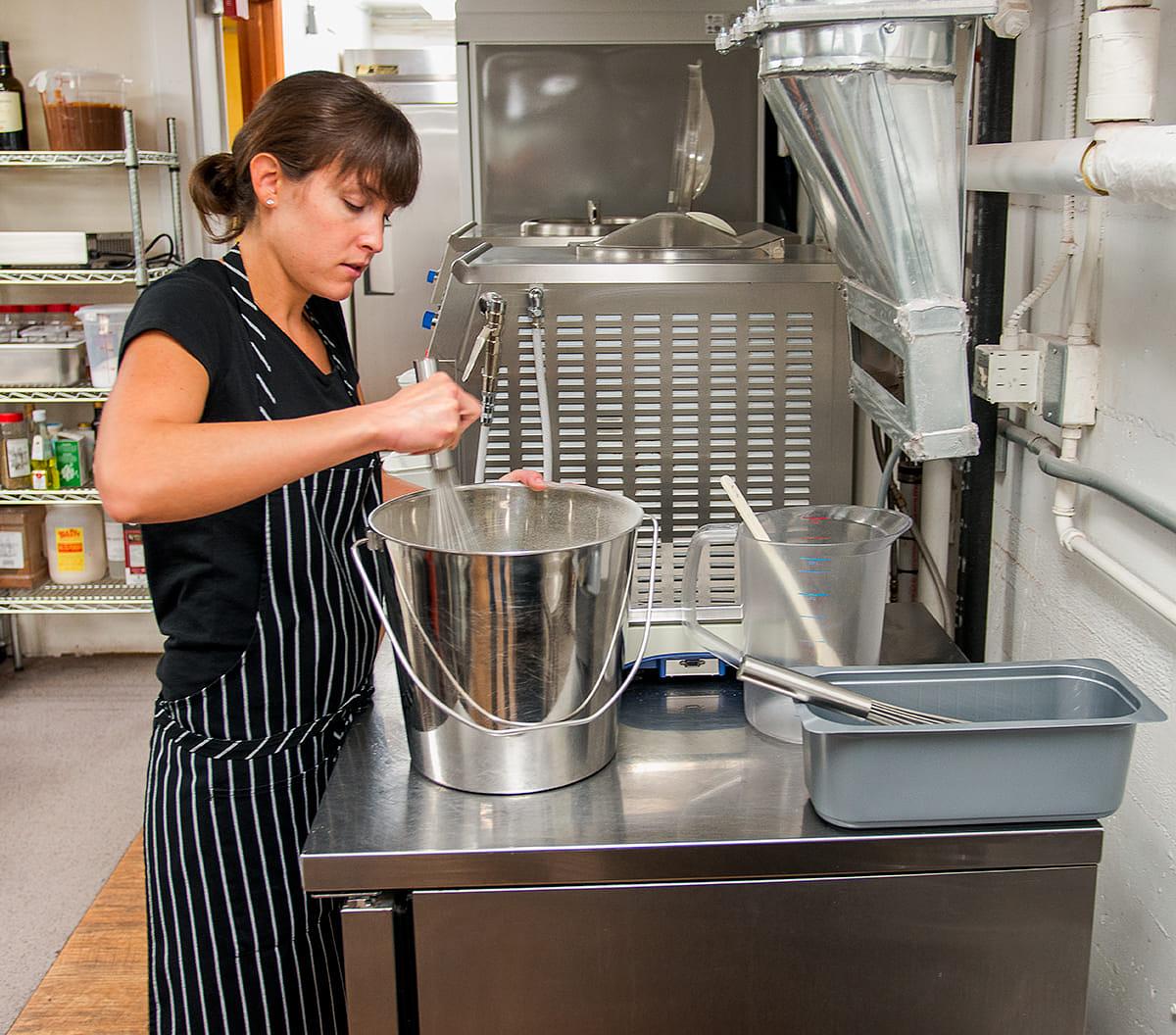
For most small to medium gelato shops opening in the USA, the Bravo Trittico is the benchmark recommendation. The Trittico is an all-in-one artisan gelato machine that handles cooking (pasteurization), aging, and batch freezing in a single unit. It produces gelato that is drier, creamier, and more stable than what most other machines can achieve — thanks to Bravo's patented Ionic System, which controls air incorporation at the molecular level during freezing.
The Trittico is 100% Italian-made and has a decades-long track record in artisan gelato shops across Europe, the United States, and internationally. It is the most widely used professional gelato machine in the world among artisan gelato makers.
Bravo offers the Trittico in multiple versions for different production volumes:
Bravo Trittico M: The professional entry-level model. Handles hot and cold processing from pasteurization through batch freezing. Ideal for gelato shops producing up to 20 to 30 kilograms of gelato per day. ETL certified for the US market. Recommended for boutique gelaterias, restaurant add-ons, and operators launching their first location.
Bravo Trittico Business: The production-grade model. Higher output capacity for busy gelato shops, bakeries, and restaurant operations needing consistent volume. Also handles granita and toppings. 100% Italian-made, ETL certified. Recommended for shops expecting to serve more than 100 customers per day or producing for wholesale accounts.
When to Choose a Dedicated Batch Freezer
If you already have a pasteurizer or plan to source pre-pasteurized gelato mix, a dedicated batch freezer gives you more flexibility and higher throughput than an all-in-one machine. The Bravo G20 Batch Freezer is specifically designed for this workflow — high-output, consistent freeze cycles, and compatible with the Bravo Equilibrio management system for recipe tracking and ingredient control. For high-volume operations, many professional gelato shops use a Trittico for base production plus a G20 for additional batch capacity.
The Bravo Gelmatic M and Pastmatic 60
For gelato makers who prefer a more traditional separate-stage approach, Bravo's Gelmatic M and Pastmatic 60 are professional pasteurizers that integrate with any batch freezer. These are popular in production kitchens where the operator wants full manual control over each stage of the process.
The Bravo Equilibrio Smart Scale System
The Bravo Equilibrio is a smart scale and app system that connects to the Trittico and guides operators through every recipe step-by-step, gram by gram. It digitizes your recipe library, tracks ingredient inventory in real time, and dramatically reduces training time for new staff. For any gelato shop planning to scale beyond the owner-operator model, the Equilibrio is a worthwhile investment.
Display Cases: Pozzetti vs Panorama
The display case is the face of your gelato shop. It is what customers see first, and it has a direct impact on purchasing behavior. There are two primary display philosophies for artisan gelato in the USA.
Pozzetti (covered tubs): The traditional Italian approach. Gelato is stored in stainless steel containers with lids, kept at -11°C to -14°C — slightly warmer than standard ice cream. This preserves the creamy, soft texture of authentic gelato and protects it from temperature fluctuations and dehydration. Pozzetti cases communicate authenticity. When an American consumer walks into a shop with a pozzetti display, they understand immediately that this is not ordinary ice cream. The IFI POZZETTI available at Modalita is the professional standard for this format.
Panorama display cases (open tubs): The open-display approach, with gelato visible and accessible in open stainless steel pans. The IFI Panorama series — including the BIT Panorama, FAST Panorama, and the Allure Panorama — uses IFI's proprietary Panorama Technology to maintain precise temperature and humidity control while keeping the product visually exposed. This format maximizes visual impact and is highly effective at driving impulse purchase decisions.
Many successful US gelaterias use a combination of both formats: Pozzetti for their classic signature flavors and a Panorama case for seasonal or featured flavors. Modalita's team can advise on the right configuration for your specific space, concept, and budget.
Complete Equipment List for a Standard Gelato Shop
Here is a practical equipment list for a stand-alone gelateria producing artisan gelato in-house:
- All-in-One Gelato Machine (Bravo Trittico M or Business): Pasteurization, aging, and batch freezing. Investment: $18,000 to $35,000.
- Additional Batch Freezer (Bravo G20, optional): Extra production capacity for high-volume operations. Investment: $12,000 to $20,000.
- Professional Gelato Display Case (IFI POZZETTI or Panorama series): Temperature-stable display for retail sale. Investment: $8,000 to $22,000 depending on size and model.
- Blast Freezer or Hardening Cabinet: Rapid hardening of freshly produced gelato before display. Investment: $5,000 to $12,000.
- Storage Freezer: Bulk storage of gelato and ingredients at -18°C. Investment: $1,500 to $4,000.
- Smart Scale System (Bravo Equilibrio): Recipe management and ingredient tracking. Investment: $800 to $2,000.
Step 5 — Designing Your Gelato Shop
In artisan gelato retail, the shop design is not decoration — it is a revenue driver. Research in retail food environments consistently shows that customers spend more, stay longer, and return more frequently in well-designed spaces. The design of a gelato shop communicates quality before the first scoop is served.
Italian design principles — clean lines, quality materials, and functional elegance — translate exceptionally well to the US market. They communicate the authenticity that American consumers associate with premium Italian products. This is a competitive advantage that most local ice cream shops simply cannot replicate.
The Service Counter and Display Layout
The display case is the central element of your floor plan. Position it to create a natural customer flow: enter, see the display immediately, move along it to make a selection, and arrive at the point of sale. Avoid layouts that require customers to navigate around the display or backtrack to pay. The service counter should be accessible from both sides for efficiency during peak hours. In compact spaces, an L-shaped or straight counter configuration typically performs best.
Materials and Finishes
The materials you choose communicate quality before a single word is spoken. Italian marble or natural stone for countertops signals premium positioning. Natural wood elements add warmth and approachability. Stainless steel accents communicate cleanliness and professionalism. Avoid plastic laminates and generic cabinetry — they undermine the premium positioning of your product no matter how good your gelato is.
Lighting
Lighting is one of the most powerful and underused tools in gelato shop design. Warm directional lighting over the display case makes gelato colors vivid and appetizing. Warm ambient lighting in the seating area creates a welcoming atmosphere that encourages customers to stay longer and spend more. Avoid cold fluorescent lighting — it makes food look unappetizing and the environment uncomfortable.
Exterior Signage and Brand Identity
Your exterior signage communicates your brand positioning before a customer steps inside. Hand-painted lettering, dimensional letters in brushed brass or steel, and illuminated signs with warm-tone LEDs are all appropriate for an artisan gelato brand. Generic plastic signage is not. Invest in professional brand identity design before you open — it will pay dividends in social media visibility and neighborhood word of mouth.
Italian Contract Furniture
If your concept includes seating, the furniture selection matters. Generic café chairs and tables undermine the artisan Italian positioning you are building. Italian contract furniture — chairs, stools, benches, and tables designed and manufactured in Italy — communicates the same values as your gelato: craftsmanship, quality, and authenticity. Modalita carries a full range of Italian contract furniture specifically curated for food and beverage environments.
The Turnkey Shop Design Advantage
The most efficient path to opening a gelato shop — in both time and total cost — is working with a single partner who handles the entire project: equipment selection, display cases, furniture, and interior design. Coordinating multiple vendors across these categories creates scheduling conflicts, design inconsistency, and often results in a space that looks assembled from separate catalogs. A cohesive Italian design concept requires a unified creative vision from the very beginning.
Modalita's Create Your Store service is the only offering in the US market that combines professional Italian gelato equipment, IFI display cases, Italian contract furniture, and complete shop design in a single engagement. It is how Morano Gelato, GROM Gelato, Sant Ambroeus, and many other acclaimed US gelaterias brought their shops to life. Browse our portfolio of completed projects here.
Step 6 — Gelato Training and Recipes
Professional gelato making is a craft skill. It is not complicated — but it requires proper training to master the balance of sugars, fats, and stabilizers that produces stable, creamy, high-quality gelato consistently. Without proper training, even the best equipment in the world will produce inconsistent results.
What Training Do You Need?
Equipment operation: How to set up, operate, clean, and maintain your Trittico or batch freezer. Bravo provides machine-specific training through authorized dealers. This is the starting point — you must know your machine before you can make great product.
Gelato formulation fundamentals: Understanding the role of each ingredient — milk, cream, sugars, stabilizers, and flavoring — and how to balance a recipe for the right texture, stability, and flavor intensity. The key variables are the sugar/water balance (POD and PAC), total solid content, and fat percentage.
Pasteurization protocols: Understanding safe food handling during the hot processing phase, temperature logging requirements, and HACCP compliance. This is both a quality control issue and a regulatory one — your health department inspector will ask about it.
Flavor development: How to build a menu of 16 to 20 core flavors plus seasonal specials that can be executed consistently by your entire team, not just the owner.
Display and merchandising: How to fill, paddle, and maintain gelato in your display case, including proper temperature management and daily rotation protocols. The visual presentation of gelato in the display case is a skill in itself.
Bravo Gelato Campus
One of the most practical training pathways for US-based gelato entrepreneurs is the Bravo Gelato Campus program offered through Modalita. This hands-on training program covers the full production workflow on Bravo equipment — from raw ingredients to finished product — led by experienced gelato professionals. The program is conducted in the USA, on the same US-market equipment you will be using in your shop, which eliminates the need to travel to Italy for foundational training.
Gelato Classes in Brooklyn
Modalita's gelato classes at our Brooklyn showroom are available for both owners and staff, covering production technique and customer service in a professional gelato shop environment. These classes are ideal for onboarding new team members and for staying current with new flavors and techniques.
Standardizing Your Recipe Library
Your recipe library is one of your most valuable business assets. It should be documented, standardized, and protected from day one. Use the Bravo Equilibrio app and smart scale system to digitize your recipes and enable your team to execute them accurately without depending on the owner's presence for every production cycle. The Equilibrio guides operators gram-by-gram through each recipe, dramatically reducing human error and cutting training time for new staff from weeks to days.
Begin with 16 to 20 core flavors that you can execute perfectly every day. Resist the temptation to launch with 40+ flavors — too many flavors means more waste, more production complexity, and lower consistency. Build depth of quality in a focused menu before expanding. Your customers will reward you for it.
Step 7 — Opening Day Checklist
The week before you open to the public is the most critical in your gelato shop's early life. Here is a practical pre-opening checklist drawn from the experience of gelato shop openings across the USA.
- All equipment installed, tested, and certified. Collect all inspection certificates and store them in a compliance file.
- Health department inspection passed and Food Service Establishment Permit posted visibly in the shop.
- Staff hired and trained. Minimum two trained staff members on opening day, more if you are launching with a soft opening event.
- Opening gelato batch produced. Run a full production cycle two to three days before opening to confirm recipes and equipment calibration.
- Display case filled and verified. Temperature confirmed, presentation paddles aligned, flavor labels in place and consistent.
- POS system fully configured. Items, pricing, tax rates, and all payment methods set up and tested with a training transaction.
- Google Business Profile set up and verified. Photos uploaded, hours confirmed, category set to Ice Cream Shop, description written with local keywords.
- Instagram and social media accounts active. Six to ten posts published before the opening day announcement to establish credibility in the feed.
- Supplier relationships confirmed. All ingredients, packaging, cups, cones, and tasting spoons stocked for a minimum of two weeks.
- Cleaning and maintenance protocols documented and assigned. Daily, weekly, and monthly tasks allocated to specific team members in writing.
- Soft launch completed. Friends, family, and neighborhood business owners invited for a private preview before the public opening. Use this session to identify service flow bottlenecks and recipe issues.
- Public opening announcement drafted and scheduled across all platforms.
- Local press and food bloggers notified at least one week in advance. A small tasting event for local media can generate significant earned coverage on opening week.
The soft launch strategy: Run a soft launch for three to five days before your public opening. This lets you identify operational problems — service flow bottlenecks, display case calibration issues, recipe adjustments — without the pressure of a full public crowd. Fix everything you learn during the soft launch before you announce publicly. This single practice has saved dozens of gelato shop openings from avoidable first-impression disasters.
Total Investment: What Does It Cost to Open a Gelato Shop in the USA?
This is the question every aspiring gelato entrepreneur asks first, and the honest answer is: it depends significantly on your market, your concept, and your approach to build-out and equipment. Here is a realistic breakdown across three different scenarios.
Scenario A — Compact Gelateria (400 to 500 square feet, urban market)
This is the most common format for a first gelato shop in a US city.
- Gelato production equipment (Bravo Trittico M or Business, scale system): $18,000 to $35,000
- Professional display case (IFI Pozzetti or Panorama, 6 to 12 flavor capacity): $8,000 to $18,000
- Refrigeration and storage (blast freezer + storage freezer): $4,000 to $10,000
- Build-out and leasehold improvements (plumbing, electrical, flooring, counters, signage): $30,000 to $80,000
- Interior design and Italian contract furniture: $8,000 to $25,000
- Permits and legal (licenses, health permits, lease attorney review): $2,000 to $6,000
- Initial inventory (ingredients, packaging, cups, cones for four to six weeks): $3,000 to $6,000
- Training (Bravo Gelato Campus or equivalent): $2,000 to $5,000
- Working capital (three to six months of operating expenses before break-even): $15,000 to $30,000
- Marketing and branding (logo, social media, opening event, digital advertising): $3,000 to $10,000
Total estimated investment: $93,000 to $225,000. The realistic average for a well-equipped, professionally designed compact gelateria in a US urban market is $120,000 to $160,000.
Scenario B — Full-Size Gelateria with Seating (700 to 1,000 square feet)
Adding seating for 20 to 30 covers significantly increases build-out costs due to additional plumbing, HVAC requirements, ADA compliance, and furniture. Expect a total investment in the range of $180,000 to $320,000 for a full-size gelateria with Italian design and seating in a major US market.
Scenario C — Gelato Cart or Market Kiosk
A professional Italian gelato cart — such as those available from TekneItalia through Modalita — combined with a compact gelato machine and a small display case can be operational for as little as $30,000 to $55,000. This is the lowest-risk entry point into gelato retail. Many successful US gelato entrepreneurs start with a cart at farmers markets or food halls, build brand recognition, and graduate to a brick-and-mortar location once they have proven demand and refined their product.
Financing Your Gelato Shop
Common and practical financing pathways for gelato shop operators in the USA include:
SBA 7(a) Loans: Up to $5 million for equipment, leasehold improvements, and working capital. Rates are competitive and terms are among the most favorable available for small business owners. Requires a solid business plan, personal credit history, and typically a 10% down payment.
SBA 504 Loans: Specifically designed for major fixed asset purchases, including commercial food equipment over $50,000. Often the most cost-effective financing structure for purchasing Italian gelato equipment at scale.
Equipment Financing: Many lenders offer equipment-specific financing for commercial food equipment, with 48 to 60-month terms and minimal down payment requirements. This is a practical option for operators who want to preserve working capital. Modalita can connect you with specialized food equipment financing partners.
USDA Business Loans: For operators in rural or suburban markets, USDA Business and Industry guaranteed loans offer favorable terms and are significantly underutilized by food entrepreneurs who qualify.
Why Partner With Modalita for Your Gelato Shop
There are several suppliers of gelato equipment in the United States. What makes Modalita different is scope. We are the only US-based company that offers a complete gelato shop solution — from the machine that makes the gelato, to the display case that showcases it, to the furniture and design that surrounds it — under one roof, with one team, and one point of accountability.
What We Offer
Professional Italian Gelato Equipment (Bravo): The full Bravo range — Trittico M, Trittico Business, G20 Batch Freezer, Gelmatic M, Pastmatic 60, and the Equilibrio smart system. All equipment is ETL-certified for the US market. Browse our gelato equipment here.
IFI Display Cases: The complete IFI range of horizontal and vertical display cases, including the POZZETTI, the full Panorama Technology series, the BIT, FAST, Allure, Tonda, and over 20 additional models. Custom configurations are available for non-standard spaces. Browse all display cases here.
Italian Contract Furniture: Chairs, stools, benches, and tables from leading Italian manufacturers, curated specifically for food and beverage environments. Browse our furniture collection here.
Complete Shop Design — Create Your Store: From concept to opening day. Layout planning, equipment placement, interior design, and project management for your entire gelato shop. Learn about our design service here.
Training and Education: Bravo Gelato Campus training, gelato classes at our Brooklyn showroom, and ongoing support from our team of gelato professionals. Bravo Gelato Campus information. Book a gelato class.
Brooklyn Showroom: We maintain a physical showroom in Brooklyn, NY, where you can see and experience every piece of equipment and furniture before you commit to a purchase. This is genuinely rare in the US professional gelato equipment market, where most suppliers operate exclusively online. Our team is available to meet with you in person to understand your project, your market, and your budget.
Who We Have Helped
Our portfolio includes some of the most recognized gelato brands in the United States. Morano Gelato — voted the best gelato in the US by Forbes — produces with Bravo Trittico equipment sourced through Modalita. GROM Gelato uses IFI display cases from our catalog. Eataly New York, Sant Ambroeus, Botolino Gelato, and dozens of independent gelaterias across the country have opened their shops with Modalita as their equipment and design partner.
We do not just sell equipment. We help entrepreneurs build gelato businesses that last. See our full portfolio of completed gelato shop projects.
If you are planning to open a gelato shop in the USA — at any stage of the process — we invite you to contact our team in Brooklyn for a free consultation. There is no obligation. We will share what we know, help you avoid the most common and costly mistakes, and give you an honest assessment of what your project will require. Contact us here.
Frequently Asked Questions About Opening a Gelato Shop in the USA
How much does it cost to open a gelato shop in the USA?
A compact gelato shop of 400 to 500 square feet in an urban US market typically requires a total investment of $93,000 to $225,000, with a realistic average of $120,000 to $160,000 for a well-equipped and professionally designed space. A full-size gelateria with seating runs $180,000 to $320,000. A gelato cart or kiosk can be launched for $30,000 to $55,000. The major cost drivers are production equipment ($18,000 to $35,000 for a Bravo Trittico), a professional display case ($8,000 to $22,000), and build-out and leasehold improvements ($30,000 to $80,000 depending on the condition of the space).
What equipment do I need to open a gelato shop?
The core equipment for a professional gelato shop includes: an all-in-one gelato machine such as the Bravo Trittico (which handles pasteurization, aging, and batch freezing in a single unit), a professional gelato display case such as the IFI POZZETTI or a model from the IFI Panorama series, a blast freezer for hardening freshly produced gelato before display, a storage freezer for bulk ingredient and product storage, and a precision scale system for recipe accuracy. All equipment must carry ETL and NSF certification for the US market.
Is a gelato shop profitable in the USA?
Yes. Artisan gelato has among the most attractive unit economics of any food business. Food cost (COGS) typically runs 20 to 28% of revenue, compared to 30 to 40% for most full-service restaurants. With an average transaction value of $8 to $14 and gross margins of 70 to 80%, a well-located gelateria serving 100 to 150 customers per day can achieve annual revenues of $400,000 to $700,000 and operating margins of 15 to 25% after reaching maturity. The key success factors are location, product quality, shop design, and consistent operations — not one of these in isolation, but all four working together.
Do I need to go to Italy to learn how to make gelato?
No. While studying in Italy is a wonderful experience and some advanced programs are available there through manufacturers like Bravo, it is not necessary to launch a successful gelato shop in the USA. The Bravo Gelato Campus program offered through Modalita in the US provides hands-on professional training on the same equipment you will use in your shop. It covers the full production workflow from raw ingredients to finished product and is designed specifically for US-based operators.
What is the difference between gelato and ice cream?
Gelato and ice cream differ in three key ways. First, fat content: gelato uses more milk and less cream, resulting in 4 to 8% butterfat versus 14 to 25% in premium American ice cream. Second, air content or overrun: gelato is churned more slowly, incorporating 20 to 35% air versus 50 to 100% in ice cream — which is why gelato is denser and more intensely flavored per gram. Third, serving temperature: gelato is served at -11°C to -14°C, warmer than ice cream, which keeps it soft and scoopable without being hard. This is why a professional gelato display case — whether pozzetti or panorama — maintains a different temperature range than a standard ice cream freezer.
What permits do I need to open a gelato shop in New York?
In New York City, you will need: a Food Service Establishment Permit from the NYC Department of Health and Mental Hygiene, a Business License from the NYC Department of Consumer and Worker Protection, a Certificate of Occupancy after your build-out, a Sales Tax Certificate of Authority from New York State, and proof of Certified Food Protection Manager certification for at least one staff member. The NYC DOHMH permitting process typically takes six to ten weeks from initial application to final permit issuance. All commercial equipment must be ETL and NSF certified.
What is the best gelato machine for a new gelato shop in the USA?
For most new gelato shops in the USA, the Bravo Trittico is the benchmark recommendation. It is an all-in-one system that handles pasteurization, aging, and batch freezing in a single unit, eliminating the need for multiple separate machines. The Trittico M is ideal for smaller shops producing up to 20 to 30 kilograms per day. The Trittico Business handles higher volumes for busier locations or wholesale production. Both models are ETL certified for the US market, use Bravo's patented Ionic System for superior texture, and are available through Modalita in Brooklyn, NY.
Where can I buy professional gelato equipment in the USA?
Modalita in Brooklyn, NY is the leading US distributor of professional Italian gelato equipment, including the complete Bravo range (Trittico, G20, Gelmatic, Pastmatic, Equilibrio) and IFI display cases. Modalita is the only US supplier offering a physical showroom where you can see and test equipment before purchasing. You can browse all gelato equipment online or contact the team directly to discuss your specific project.