
Last updated: August 2026 · Reading time: ~13 minutes
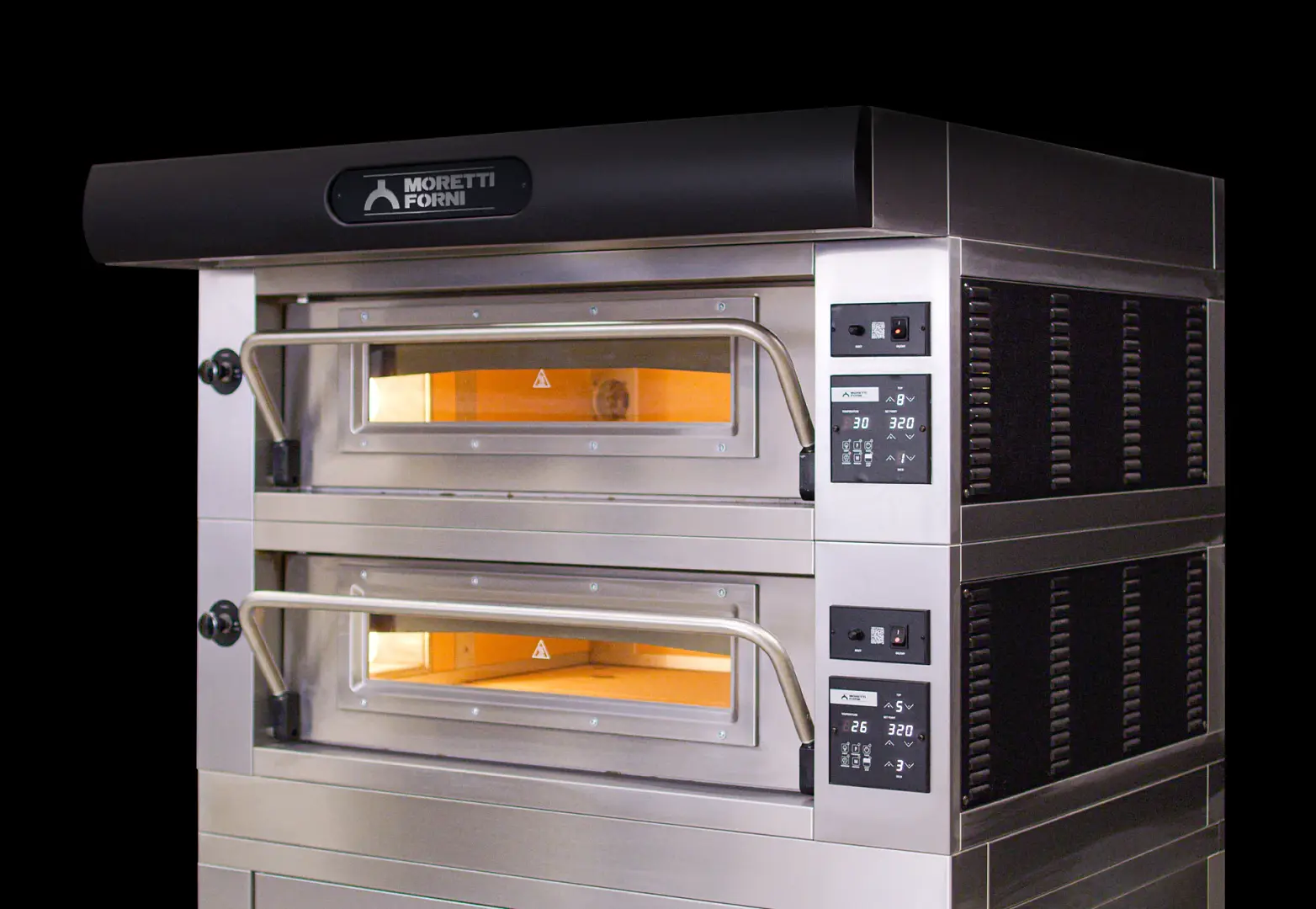
If your concept is built entirely around Neapolitan-style pizza, you've probably already had the conversation with yourself: wood-fired, or something that performs like wood-fired without actually being wood-fired? The Moretti Forni AMALFI exists for exactly that fork in the road. It's an all-electric oven with a baking chamber built entirely from refractory brick — the same material that has defined authentic pizza baking for a century — engineered to deliver the radiant heat and crust character of a traditional oven without a flue, a fuel delivery schedule, or a compliance file with the city.
This guide covers what the AMALFI actually is, how its refractory-brick construction works, the full range of chamber sizes and outputs, an honest comparison against both a true wood-fired oven and Moretti Forni's own Serie S, the regulatory backdrop that's making electric refractory ovens a serious conversation in cities like New York, and how to buy one through Modalita — the authorized Moretti Forni dealer on the East Coast, based in Brooklyn.
Table of Contents
- Quick Answer: Is the AMALFI Right for You?
- What Is the Moretti Forni AMALFI?
- How AMALFI Replicates a Traditional Bake — Without a Fire
- Why US Pizzerias Are Rethinking Wood and Coal Ovens
- AMALFI Model Range: Sizes A Through D
- Design, Controls, and Build Quality
- AMALFI vs a True Wood-Fired Oven — An Honest Comparison
- AMALFI vs Serie S — Which Moretti Forni Oven Fits Your Concept?
- Installation and Compliance in the USA
- Who Is the AMALFI For?
- How to Buy an AMALFI in the USA
- Frequently Asked Questions
Quick Answer: Is the AMALFI Right for You?
The AMALFI is the right oven if: your menu is built around Neapolitan or traditional Italian pizza specifically, you want the radiant, high-retention bake of a masonry oven, and you operate in a market — like New York City — where installing or maintaining a solid-fuel oven means extra permitting, engineering assessments, and emissions compliance you'd rather not deal with.
It is not the right oven if: your menu spans multiple product categories (bread, pastry, multiple pizza styles) — in that case the modular Serie S is the more versatile platform — or if an open flame and visible wood combustion are themselves part of your dining room's theater and brand identity, which no electric oven, however good, will replicate.
The rest of this guide gives you the detail to make that call with confidence.
What Is the Moretti Forni AMALFI?
The AMALFI is a professional electric deck oven built by Moretti Forni, part of the manufacturer's serieP range, and sold in the US through Modalita as the authorized East Coast dealer. Unlike general-purpose deck ovens that use a mix of steel and refractory panels, the AMALFI's baking chamber is built entirely from refractory brick — floor and ceiling — which is the same construction principle behind traditional masonry pizza ovens.
What makes the AMALFI different from simply lining a steel box with brick is where the heat comes from. The heating elements aren't mounted above or below the chamber and radiated inward — they're inserted directly inside the refractory stone itself, separately for the ceiling and the floor. That's a meaningfully different approach to heat delivery, and it's the detail that defines everything else about how this oven performs.
Each AMALFI unit is manufactured in Italy and, per Moretti Forni's own description of the line, built as an individual piece rather than off an assembly-line template — consistent with how the company treats its higher-end professional ovens generally.
How AMALFI Replicates a Traditional Bake — Without a Fire
Three things happen when heating elements are embedded inside refractory brick rather than sitting behind a steel panel:
Heat Retention Under Load
Refractory brick has enormous thermal mass. It absorbs heat slowly and releases it slowly. In a traditional wood oven, this is what lets the deck stay hot through a busy service even as you're constantly opening the door and loading cold dough. The AMALFI's brick-and-embedded-element construction is engineered to deliver the same behavior electrically: the chamber holds its temperature through frequent door openings instead of spiking and dipping the way a thinner, less thermally massive chamber would.
Radiant, Even Heat Distribution
Because the heating elements sit inside the stone on both the ceiling and the floor — independently — the oven can balance top and bottom heat precisely, and that heat radiates from the entire brick surface rather than from a single element or burner. The practical result is a bake that browns and blisters the way a masonry oven does, rather than the more uniform, flatter bake you get from a standard electric deck.
No Combustion, No Flue, No Fuel Chain
None of that requires burning anything. There's no wood to source, season, and store; no ash to remove; no chimney or flue to install, inspect, and maintain; and no combustion byproducts to manage. The oven plugs into a standard commercial three-phase electrical supply, and heat behavior that once required an open flame is produced entirely through the brick-and-element system described above.
This is the core trade the AMALFI is built around: the thermal character of a masonry oven, delivered without the fuel logistics, venting infrastructure, and — increasingly, in cities like New York — the regulatory overhead of a solid-fuel installation.
Why US Pizzerias Are Rethinking Wood and Coal Ovens
This isn't a hypothetical concern. New York City has spent the last several years actively tightening the rules around solid-fuel cooking equipment, and it's worth understanding the actual scope of it before deciding this doesn't apply to you.
A New York City Council law passed in 2015, followed by a 2016 Department of Environmental Protection rule, requires wood- and coal-fired cook stoves installed before May 2016 to be assessed for emissions reduction. Affected restaurants must hire a licensed engineer to evaluate whether an emission control device — typically an exhaust scrubber that recirculates smoke through a filtration system — can cut particulate emissions by 75%. If a 75% reduction isn't achievable, the operator has to document why, and show whatever reduction (at minimum 25%) is achievable instead. The original compliance deadline was January 2020; it slipped due to the pandemic, and the DEP resumed active enforcement in subsequent years. Roughly 130 New York City pizzerias fall under this rule.
The point isn't that wood and coal ovens are banned in New York — they aren't. The point is that owning or installing one now comes with a real, ongoing compliance obligation: an engineering assessment, potential capital spend on emissions equipment, and exposure to a regulatory process that can change. For an operator opening a new location, or replacing an aging oven, that's a meaningful variable to weigh against equipment that simply doesn't trigger the conversation in the first place — which is exactly the case an all-electric, refractory-brick oven like the AMALFI makes for itself.
If you're building a new pizzeria anywhere with dense residential zoning or an active air-quality agenda — and that increasingly describes most major US metros, not only New York — it's worth having this conversation with your architect and your equipment supplier before you commit to a venting plan, not after.
AMALFI Model Range: Sizes A Through D
The AMALFI is available in four baking chamber sizes — A, B, C, and D — each offered in single, double, or triple-deck configurations depending on the size. Modalita specifies the exact configuration to your production requirements; here's the range to help you scope what you likely need.
SizeApprox. Chamber DimensionsDeck ConfigurationsBest ForA26" × 41" per deck1 or 2 decksSmaller footprint pizzerias, single-concept operationsB38" × 29" per deck2 decksWider, shallower format — good for compact kitchens needing deck widthC38" × 41" per deck1, 2, or 3 decksFull-service pizzerias, the most common configuration rangeD46" × 44" per deck1 deck (largest single-deck chamber)High-volume single-deck operations, largest simultaneous batch size.
To make the output difference concrete: Modalita's own AMALFI D specification bakes up to 12 pizzas (12" / 30cm) simultaneously, for a rated output of roughly 180 pizzas per hour — or, on family-size pies (14" / 35cm), around 135 per hour. The same chamber can run 32 trays (24" × 16" / 60×40cm) per hour when configured for indirect baking on trays rather than direct-deck pizza. Multiply that by two or three decks in the A, B, or C sizes and you can scope output for a wide range of volume targets.
All sizes are also available with an optional steam generator, a fully stainless-steel front hood on request, and a higher-clearance deck option for taller products. Contact Modalita with your target hourly output and kitchen footprint, and our team will match you to the specific size and deck count — pricing isn't published because it depends entirely on that configuration.
Design, Controls, and Build Quality
Every AMALFI runs on Moretti Forni's Moretti System Control board, which lets you set ceiling and floor heat independently, program a switch-on timer so the oven is at temperature before your first ticket of the day, run an economy mode during slow periods, and save cooking programs for different products. The doors are heavy-duty, insulated with high-density fiber, and the glass panel can be replaced from the outside — a small detail, but one that matters when a cracked door glass would otherwise mean downtime during service. The exterior dashboard is finished in black, a consistent design signature across Moretti Forni's serieP range, and the oven ships with a wide list of optional accessories to match specific kitchen layouts.
None of this is decorative flourish. In a segment where a lot of "traditional-style" ovens are really just a steel box with a brick veneer bolted on, the AMALFI's refractory-brick construction and embedded heating elements are structural to how it bakes — not styling applied after the engineering was done.
AMALFI vs a True Wood-Fired Oven — An Honest Comparison
We're not going to tell you the AMALFI is identical to a wood-fired oven, because it isn't, and any Neapolitan purist will tell you the same. Here's where the two genuinely differ, and where they don't.
Where wood-fired still wins
A true wood-fired oven imparts subtle smoke character that no electric oven, regardless of brick construction, can fully replicate. If that specific flavor profile is core to your product and your brand story — the visible flame, the wood smell, the theater of a pizzaiolo working an open hearth — that's a real and legitimate reason to stay wood-fired, and it's worth the fuel logistics and compliance overhead that comes with it.
Where AMALFI wins
Everything else. Temperature consistency that doesn't depend on how well your staff manages a fire that night. No fuel storage, delivery schedule, or ash removal. No flue installation or inspection. No exposure to the NYC-style emissions compliance process described above — or the equivalent conversation in any other dense urban market watching air quality more closely each year. Faster startup and shutdown. And a bake that, while not chemically identical to wood smoke, delivers the radiant heat, crust blister, and char character that most customers associate with "authentic" without them ever knowing there's no fire involved.
For the large majority of US pizzerias building a Neapolitan-style menu — where the goal is an authentic-tasting, consistently produced pizza rather than a wood-burning demonstration — the AMALFI closes that gap convincingly enough that the operational case tips clearly in its favor.
AMALFI vs Serie S — Which Moretti Forni Oven Fits Your Concept?
Both are excellent electric ovens built by the same manufacturer, and Modalita sells both — so it's a fair question, and the answer comes down to menu breadth, not quality.
The Serie S is a modular platform: six interchangeable baking chamber types (including its own Stonebake chamber for Neapolitan-style pizza), independent deck temperatures, and the ability to run pizza on one deck and pastry or bread on another, simultaneously. It's the right choice if your menu spans multiple product categories, or if you expect your concept to evolve.
The AMALFI does one thing — refractory-brick, traditional-style pizza baking — and does it with a chamber built specifically around that single job, at a lower entry price point than a comparable Serie S configuration. If your concept is, and will stay, 100% Neapolitan or traditional Italian pizza, the AMALFI's focused construction is arguably the more direct tool for the job, and you're not paying for chamber-type flexibility you'll never use.
Operators who aren't sure yet often start this conversation by asking us to compare the two side by side against their specific menu plan — that's a five-minute conversation with our team, not something you need to figure out alone from a spec sheet.
Installation and Compliance in the USA
The AMALFI requires a standard commercial three-phase electrical supply, the same as Moretti Forni's other electric ovens — verify available amperage and phase with your electrician before finalizing your kitchen layout, particularly if you're converting a space that wasn't previously a commercial kitchen. Because the AMALFI produces no combustion byproducts, its ventilation requirements are simpler than a wood or coal oven's: standard commercial kitchen exhaust is generally sufficient, with the specific requirement set by your local health department and building code, not by the oven itself.
This is, practically speaking, the installation-side payoff of everything covered in the regulations section above: no flue to permit, no engineering assessment to commission, no emissions equipment to budget for. Your contractor plans around a standard electrical and ventilation installation, full stop.
Modalita provides technical documentation for your electrician and contractor, and our team can walk your local health department requirements with you as part of the buying process.
Who Is the AMALFI For?
Neapolitan and Traditional Pizza Specialists
If your entire menu is built around Neapolitan or traditional Italian-style pizza, the AMALFI is purpose-built for exactly that job — a refractory-brick chamber engineered around one product category, not a generalist platform adapted to it.
Operators in Regulated or Space-Constrained Urban Markets
For pizzerias opening in New York City specifically, or any dense urban market where solid-fuel cooking equipment draws increasing regulatory and community scrutiny, the AMALFI sidesteps the entire conversation — no flue, no fuel storage, no emissions filing.
Operators Replacing an Aging Wood or Coal Oven
If you're one of the roughly 130 NYC pizzerias — or the equivalent in another city — facing an emissions assessment on an existing solid-fuel oven, replacing it with an AMALFI removes the underlying issue rather than adding compliance equipment to work around it.
New Concepts Wanting an Authentic Look Without an Open Flame
Insurance requirements, landlord restrictions, and lease terms in many commercial spaces make an open wood flame difficult or impossible to place, particularly in multi-tenant buildings. The AMALFI delivers the visual and flavor character associated with traditional baking in a form factor that fits standard commercial lease and insurance requirements.
How to Buy an AMALFI in the USA
Moretti Forni sells through authorized dealers only. Modalita is the authorized East Coast dealer, based in Brooklyn, New York, and stocks and specifies the full AMALFI range.
Step 1 — Define Your Production Requirements
Tell us your target hourly pizza output, kitchen footprint, and whether you need direct-deck baking, tray baking, or both. That's enough for our team to narrow you to the right chamber size and deck count before you look at a single spec sheet.
Step 2 — Visit the Brooklyn Showroom
Seeing and, ideally, baking on an AMALFI in person before committing to a five-figure equipment purchase is worth the trip. You'll get a direct sense of the chamber's heat behavior, the door mechanism, and the build quality that a product photo can't convey.
Step 3 — Configuration and Quote
Once your requirements are clear, we'll finalize chamber size, deck count, and any accessories (steam generator, stainless hood, higher-clearance deck) and prepare a full quote covering the oven, stand, and logistics to your location.
Step 4 — Installation and Training
We coordinate with your electrician on the three-phase connection and provide operational training on the Moretti System Control board — temperature programming, economy mode, and maintenance routines — so your team gets full performance from day one.
Ready to talk specifics? Contact the Modalita team for a consultation and quote. We respond within one business day.
Weighing gas against electric before you commit to an oven type at all? Our gas vs. electric pizza oven comparison covers the broader decision. And if your concept needs a more versatile platform across multiple product types, see our complete guide to the Moretti Forni Serie S.
Planning a full buildout that includes a gelato or dessert program alongside your pizza operation? See our guide on how to open a gelato shop in the USA — Modalita sources both the oven and the gelato equipment from one point of contact.
Frequently Asked Questions
What is the Moretti Forni AMALFI?
The AMALFI is a professional electric pizza oven manufactured by Moretti Forni in Italy, part of the serieP range. Its baking chamber is built entirely from refractory brick, with heating elements inserted directly inside the stone for both the ceiling and floor, producing the radiant, high-retention bake associated with traditional masonry ovens — without burning wood or coal. It's available in the US through Modalita, the authorized East Coast dealer in Brooklyn, New York.
Is the AMALFI as good as a wood-fired oven?
It doesn't impart the same subtle smoke character a true wood fire does, and purists will notice the difference. But for radiant heat, crust blister and char, and temperature consistency, the AMALFI's refractory-brick construction gets close enough that most customers won't tell the difference — while eliminating fuel logistics, flue installation, and the emissions compliance overhead that comes with a solid-fuel oven in cities like New York.
What sizes does the AMALFI come in?
Four chamber sizes — A, B, C, and D — in single, double, or triple-deck configurations depending on size. The largest single-deck chamber (size D) bakes up to 12 pizzas (12"/30cm) simultaneously for a rated output around 180 pizzas per hour. Contact Modalita with your target output and kitchen footprint for a specific configuration recommendation.
Does the AMALFI require special ventilation like a wood-fired oven?
No. The AMALFI produces no combustion byproducts, so it doesn't require a flue, chimney, or the emissions equipment that wood- and coal-fired ovens increasingly need in cities like New York. Standard commercial kitchen ventilation, per your local health code, is generally sufficient.
Why are NYC pizzerias dealing with wood and coal oven regulations?
A 2015 New York City Council law and a follow-up 2016 DEP rule require wood- and coal-fired cook stoves installed before May 2016 to undergo an emissions assessment, with operators required to cut particulate emissions by up to 75% via equipment like exhaust scrubbers, or document why that's not achievable. Roughly 130 NYC pizzerias are affected. It's a compliance and cost issue, not a citywide ban — but it's a real factor to weigh against equipment, like the AMALFI, that doesn't trigger the requirement at all.
How does the AMALFI compare to the Moretti Forni Serie S?
The Serie S is a modular platform with six interchangeable chamber types, suited to operations baking multiple product categories (pizza, bread, pastry) from one oven. The AMALFI is purpose-built for one job — traditional refractory-brick pizza baking — typically at a lower entry price than a comparable Serie S configuration. If your menu is and will remain Neapolitan-focused, the AMALFI is the more direct tool.
What electrical supply does the AMALFI need?
Standard commercial three-phase electrical supply, consistent with Moretti Forni's other electric ovens. Confirm available phase and amperage with your electrician before finalizing your kitchen plan.
Does the AMALFI come with a steam generator?
An optional steam generator is available on all AMALFI sizes, along with a fully stainless-steel front hood and a higher-clearance deck option for taller products, on request.
How much does a Moretti Forni AMALFI cost?
Pricing depends on chamber size, deck count, and selected accessories, and isn't published online for that reason. Contact Modalita for a configuration-specific quote.
Where can I buy a Moretti Forni AMALFI in the USA?
Modalita is the authorized Moretti Forni dealer on the East Coast, based in Brooklyn, New York. We handle consultation, configuration, logistics, installation support, and after-sales service. Contact us here, visit our Brooklyn showroom, or browse the full Moretti Forni oven lineup on our site.
About Modalita: Modalita is the authorized East Coast distributor for Moretti Forni, Bravo gelato equipment, and IFI display cases in the United States. Based in Brooklyn, New York, we supply professional food service equipment to pizzerias, gelaterie, bakeries, restaurants, and hotels across the East Coast. Our team provides full consultation, configuration support, and after-sales service for every product we carry. Learn more about us or get in touch directly.